

A parenting plan in Maryland is a written agreement that sets out how parents will share decision-making and time with their children after separation. Maryland courts require one in every custody case. A working plan covers the regular schedule, holidays, major decisions, communication, and how future disagreements will be resolved. If parents cannot agree, they must file a Joint Statement, and the court decides the disputed issues.
A parenting plan in Maryland does more than satisfy a filing requirement. When it is detailed and realistic, it becomes the roadmap your family follows for years, reducing arguments and the need to return to court. When it is vague, it becomes the source of the next dispute. The difference usually comes down to how carefully you build the plan.
What Maryland Courts Require
The Maryland Judiciary requires parties to submit a parenting plan in any case involving custody of a minor child. Parents receive the court’s Parenting Plan Instructions and Parenting Plan Tool at their first hearing, and they must file both documents with a notice regarding restricted information.
If parents cannot reach agreement, they must file a Joint Statement of the Parties Concerning Decision-Making Authority and Parenting Time. The Joint Statement identifies areas of agreement and disagreement, and it is generally due at least 10 days before a settlement conference, or 20 days before trial if there is no settlement conference. Understanding the difference between legal and physical custody before you begin is essential, and our guide to the types of child custody in Maryland explains both.
The Core Parts of a Maryland Parenting Plan
A workable plan addresses each of the following areas in specific terms.
| Section | What It Should Address |
|---|---|
| Decision-making | Who decides education, medical and mental health care, religious upbringing, and extracurricular activities, and how joint decisions are made |
| Regular schedule | Which days and overnights the child spends in each home during the school year and summer |
| Holidays and special days | Birthdays, Mother’s Day, Father’s Day, school breaks, and major holidays, often alternating by year |
| Exchanges | Where, when, and how the child moves between homes, including who provides transportation |
| Communication | How parents share information and how the child contacts the other parent |
| Travel and relocation | Notice required for vacations, out-of-state travel, and any proposed move |
| Dispute resolution | Whether parents will use mediation or another step before returning to court |
Choosing a Schedule That Fits Your Family
There is no single correct schedule. Younger children often do better with shorter, more frequent time with each parent, while teenagers may need a schedule built around school, activities, and jobs. Distance between homes, work hours, and each parent’s past involvement all matter.
The schedule also affects child support. Under Maryland’s guidelines, the shared physical custody calculation can apply when a parent has at least 92 overnights a year. The chart below shows roughly how common schedules compare to that threshold.
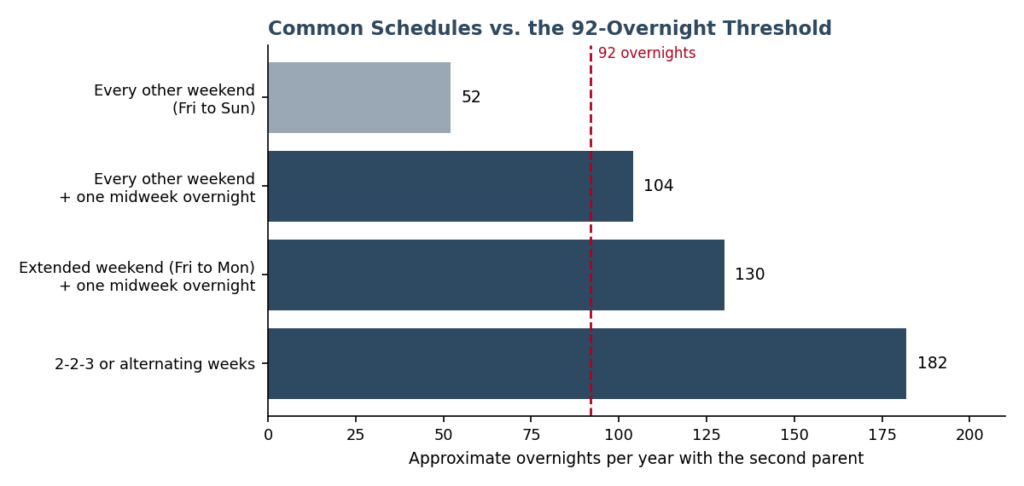
Overnights calculated from each schedule’s 14-day cycle and rounded. Actual totals depend on holiday and summer terms.
Because even one added overnight every two weeks can change the calculation, review the schedule and child support in Maryland together, not as separate negotiations. Parents hoping for an equal arrangement should also read our article on how to get 50/50 custody.
Details That Keep a Plan From Falling Apart
Most parenting plan disputes come from situations the plan never anticipated. Strong plans address:
- Exact exchange times and a fallback location if the primary one is unavailable.
- What happens when a child is sick on a scheduled exchange day.
- Right of first refusal when a parent cannot care for the child during their time.
- A shared calendar or co-parenting app for schedules, expenses, and school information.
- How holiday time interacts with the regular schedule when they overlap.
- How the plan will adjust as the child starts school, reaches middle school, or begins driving.
Good co-parenting habits make these terms easier to follow, and our article on what co-parenting looks like in practice offers practical guidance.
Want a Parenting Plan That Holds Up?
Patrick handles every custody case personally and knows how Anne Arundel County judges approach parenting time. One client who went through a custody trial with Patrick came away with joint physical and joint legal custody of their 16-month-old son. Call (410) 216-7905 or schedule a consultation to start building your plan.
When Parents Cannot Agree
If negotiations stall, the court may order mediation, and mediation often resolves some or all of the parenting plan. Where agreement is not possible, the judge decides the disputed issues based on the child’s best interest, weighing the factors Maryland courts now apply, which we explain in our guide to how Maryland decides child custody.
Some situations call for a different approach entirely. If there are safety concerns, a history of abuse, or one parent is unable to cooperate, a plan built around sole custody in Maryland or supervised time may be more appropriate than shared decision-making.
Common Concerns About Parenting Plans
We Get Along, So Do We Need Much Detail?
Yes. Plans written during a cooperative period are the ones parents rely on when circumstances change, such as a new partner, a job relocation, or a disagreement about school. Detail protects the relationship you have now.
Will a Judge Just Approve Whatever We Agree To?
Courts generally respect agreements between parents, but the judge must still find that the arrangement serves the child’s best interest. A clear, thoughtful plan makes that finding easier.
What if the Plan Stops Working?
Plans can be updated by agreement, and courts can modify custody orders when circumstances materially change. Our page on modifying a custody order in Maryland explains that process.
What Happens When You Call
When you call (410) 216-7905, you speak with Patrick or hear back from him directly, usually within a few hours. He will ask about your children’s ages and routines, your current arrangement, and whether a custody case has already been filed. You will leave the conversation understanding what your parenting plan should include and the best path to getting it in place.
Frequently Asked Questions
Is a parenting plan required in Maryland?
Yes. Maryland courts require parties to submit a parenting plan in any case involving custody of a minor child. Parents receive the court’s parenting plan instructions and tool at their first hearing.
What if my co-parent and I cannot agree on a parenting plan?
If you cannot agree, you must file a Joint Statement of the Parties Concerning Decision-Making Authority and Parenting Time. It identifies where you agree and disagree, and the court then decides the disputed issues based on the child’s best interest.
Do I have to use the Maryland Parenting Plan Tool?
The court’s tool is a model, not the only acceptable format. Many parents use it as a starting point and add terms that fit their family. An attorney can help make sure your version is clear and enforceable.
Can a parenting plan affect child support?
Yes. Maryland’s child support guidelines consider overnights. When a parent has at least 92 overnights a year, the shared physical custody calculation can apply, which may change the support amount.
Can we change our parenting plan later?
Parents can agree to changes and submit a consent order. If one parent objects, the other must generally show a material change in circumstances and that the modification serves the child’s best interest.
Should a mediator help us write our parenting plan?
Mediation works well for many families, and the court may order it. It is generally not appropriate where there is a history of abuse or safety concerns.
Related Child Custody Resources
A parenting plan is one piece of the broader custody process. Parents can learn more about how Patrick represents families in child custody cases in Anne Arundel County, and those going through a separation can review our guide to contested divorce in Maryland.
Build Your Maryland Parenting Plan With Confidence
A parenting plan shapes your children’s routines for years. Clients describe Patrick as knowledgeable and relentless, and one noted that he still answers questions even after a case has settled. Call the Law Office of Patrick Crawford at (410) 216-7905 or contact the office online to talk through your family’s plan.